For searchers buying ops-heavy small businesses

Find the constraint before you close. Run the back office after.

Operations diligence pre-close, then an AI-run back office post-close: monthly close, KPI dashboards and constraint-lens reviews. AI agents do the work. A 25-year operator reviews and signs off. Your accountant stays reviewer of record.

Constraint review Illustrative
  1. 1
    IdentifyThe one constraint on throughput or cash
    Named
  2. 2
    ExploitGet more from it before spending anything
    Plan
  3. 3
    SubordinateLine everything else up behind it
    In review
  4. 4
    ElevateAdd capacity only if still needed
    Later
  5. 5
    Re-checkDon't let last quarter's fix become inertia
    Quarterly
Prepared by AI agentsSigned off by Nick Jeffers
  • Light manufacturing
  • Field services
  • Distribution
  • B2B services

Services

One operator lens, before and after the close.

QoE tells you whether the earnings are real. Operations diligence tells you whether the business can keep producing them, and what limits it. After close, the same lens runs the monthly cadence.

Pre-close

Operations diligence

For searchers with a live LOI. Built to sit in the lender package and become the 100-day plan.

  • Constraint-lens diagnostic. The one bottleneck that limits throughput and cash flow, with the evidence and the dollar math.
  • Seller interview guide and site-visit checklist, built for your deal.
  • Operational red flags. Key-person risk, customer and supplier concentration, capacity, maintenance debt.
  • 100-day post-close plan with the KPIs to track it.
Post-close

AI-run back office

An operating cadence that starts at the constraint, prepared for your accountant to review.

  • Monthly close. P&L, balance sheet, cash and a short owner note, under your accountant's review.
  • KPI dashboards. A weekly scorecard, a monthly dashboard against target, a quarterly review.
  • Cash visibility. AR and AP aging, a 13-week cash view, the exception list.
  • Constraint-lens reviews. Is the named constraint still the constraint? What's the next move?

Method

Effort goes to the constraint, not the punch list.

Most acquired companies don't fail for lack of reports. They fail because effort goes to the wrong thing. We use the public Theory of Constraints focusing process: name the constraint, price it, exploit it, subordinate to it, elevate only if needed, and re-check. The first move is rarely a new hire or a new machine.

Weekly

Scorecard

One page on the 5–8 operating KPIs that reveal the constraint, and a short note on what moved.

Monthly

Close and dashboard

The close, a dashboard against target and a 13-week cash view, typically by about day 5, ready for accountant review.

Quarterly

Constraint review

EBITDA versus plan, the initiatives on the constraint, and the decisions only the owner makes: hire, spend, price.

01AI agents prepare

The close, scorecards, diagnostics and drafts.

02Nick reviews and signs off

An operator checks every deliverable before you see it.

03Your accountant reviews

They stay reviewer of record on the books.

04You decide

The owner keeps every human sign-off.

Sample reports

What the constraint lens produces.

Screens from a Constraint Lens review of a fictional commercial HVAC service business. Every company name and number here is example data, not a client result. Select any screen to open it full size.

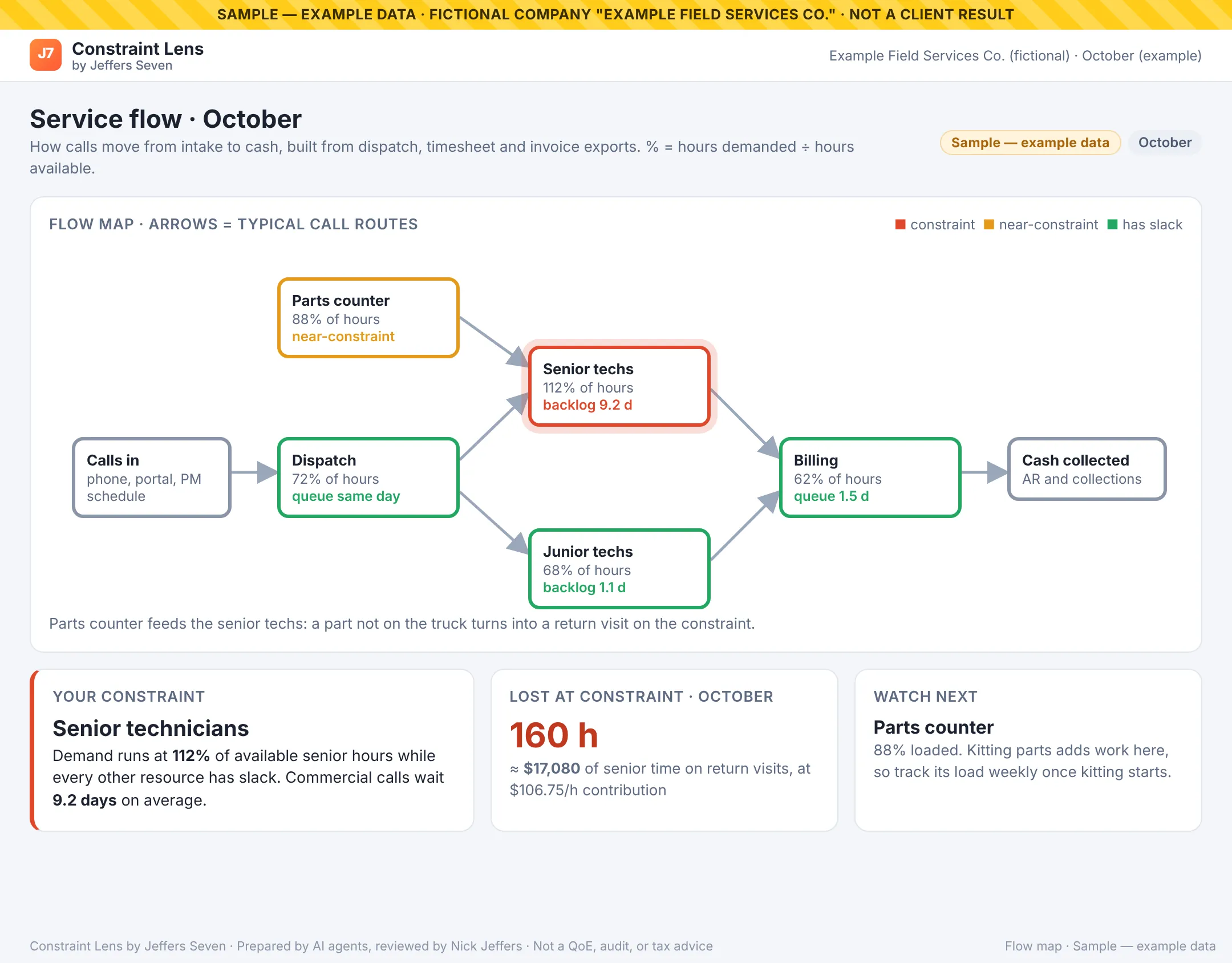
Sample Constraint Lens flow map, labeled Sample — example data, for a fictional field-services company. Calls in, dispatch at 72%, parts counter at 88%, senior techs at 112% highlighted as the constraint with a 9.2-day backlog, junior techs at 68%, billing at 62%. Below: 160 senior hours lost in October, about $17,080.
Service flow mapHow calls move from intake to cash, with each resource's load. The one over 100% is the constraint; the near-constraint is flagged to watch.Sample — example data
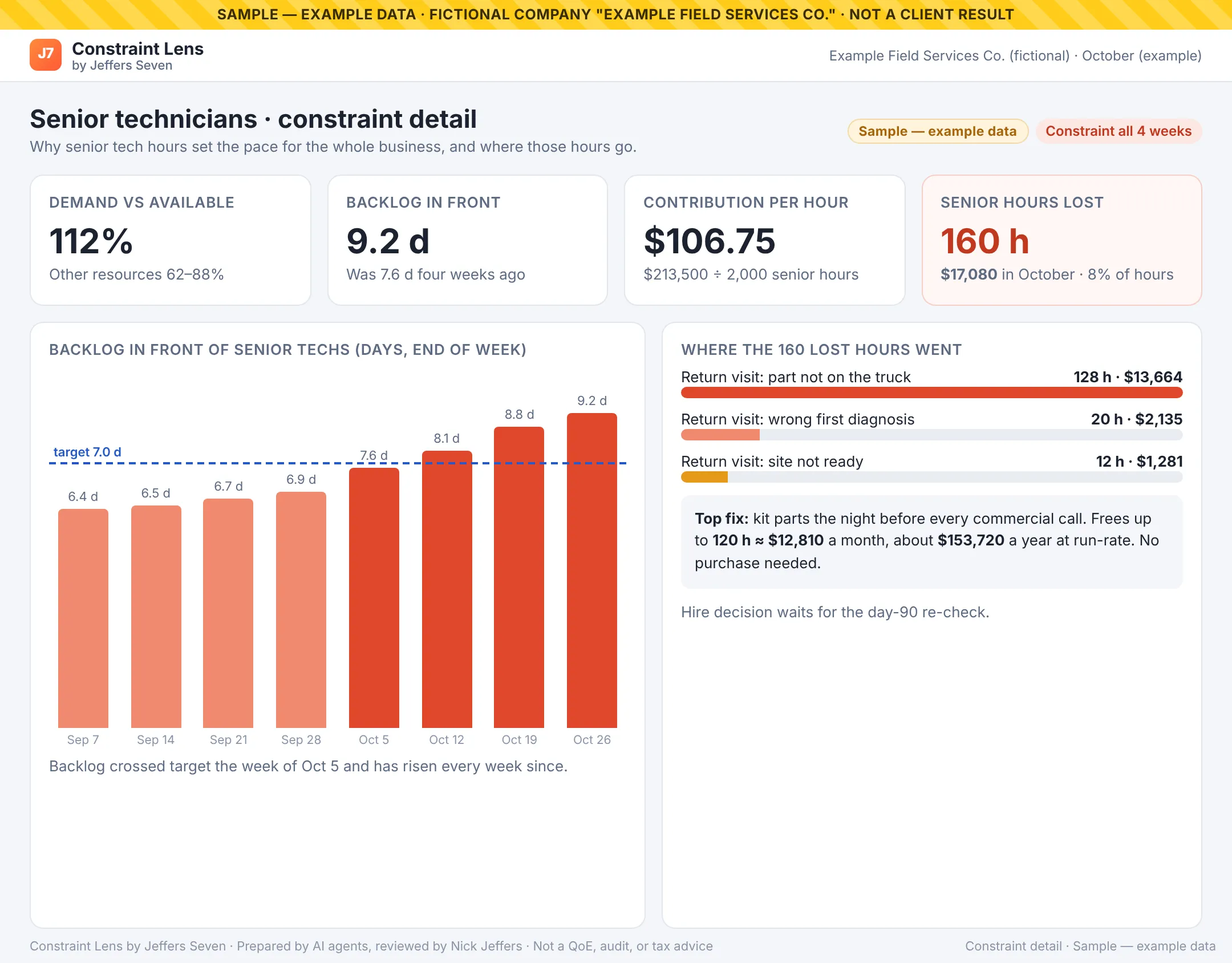
Sample constraint detail screen, labeled Sample — example data. Senior technicians: 112% demand vs available, 9.2-day backlog, $106.75 contribution per hour, 160 hours lost. Weekly backlog bar chart rising past a 7-day target, and a breakdown of return visits, led by parts not on the truck at 128 hours. Top fix: kit parts, freeing up to 120 hours, about $12,810 a month.
Constraint detailLoad, backlog and contribution per constraint hour, where the lost hours went, and the top fix with its throughput math.Sample — example data
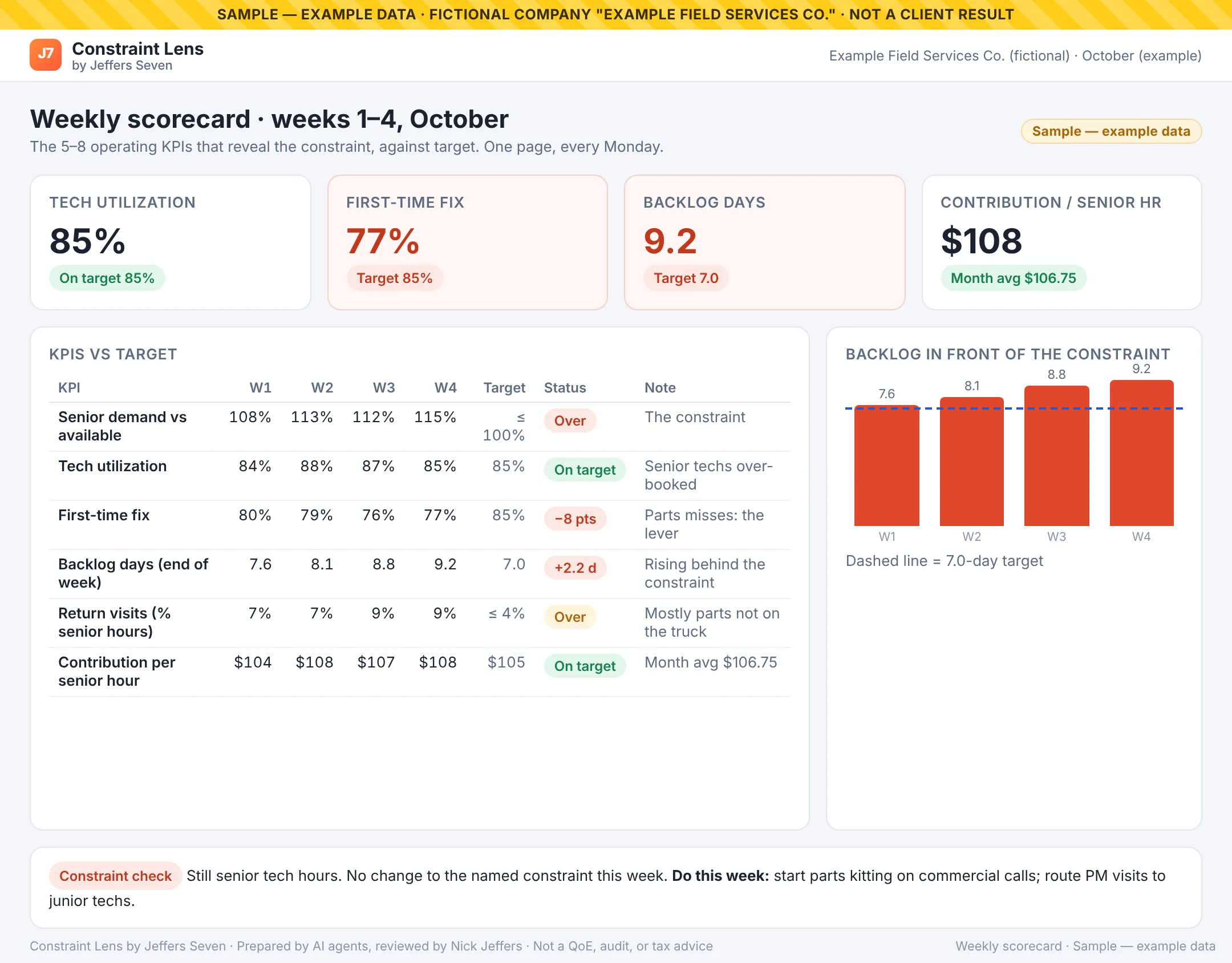
Sample weekly scorecard, labeled Sample — example data, for weeks 1 to 4 of October: senior demand 108 to 115% of hours, utilization 85%, first-time fix 77% against 85%, backlog 9.2 days against 7.0, return visits 9%, contribution per senior hour $108. Includes a backlog bar chart and a constraint check note.
Weekly KPI scorecardThe KPIs that reveal the constraint, week by week against target, with status chips and a weekly check that the constraint still holds.Sample — example data
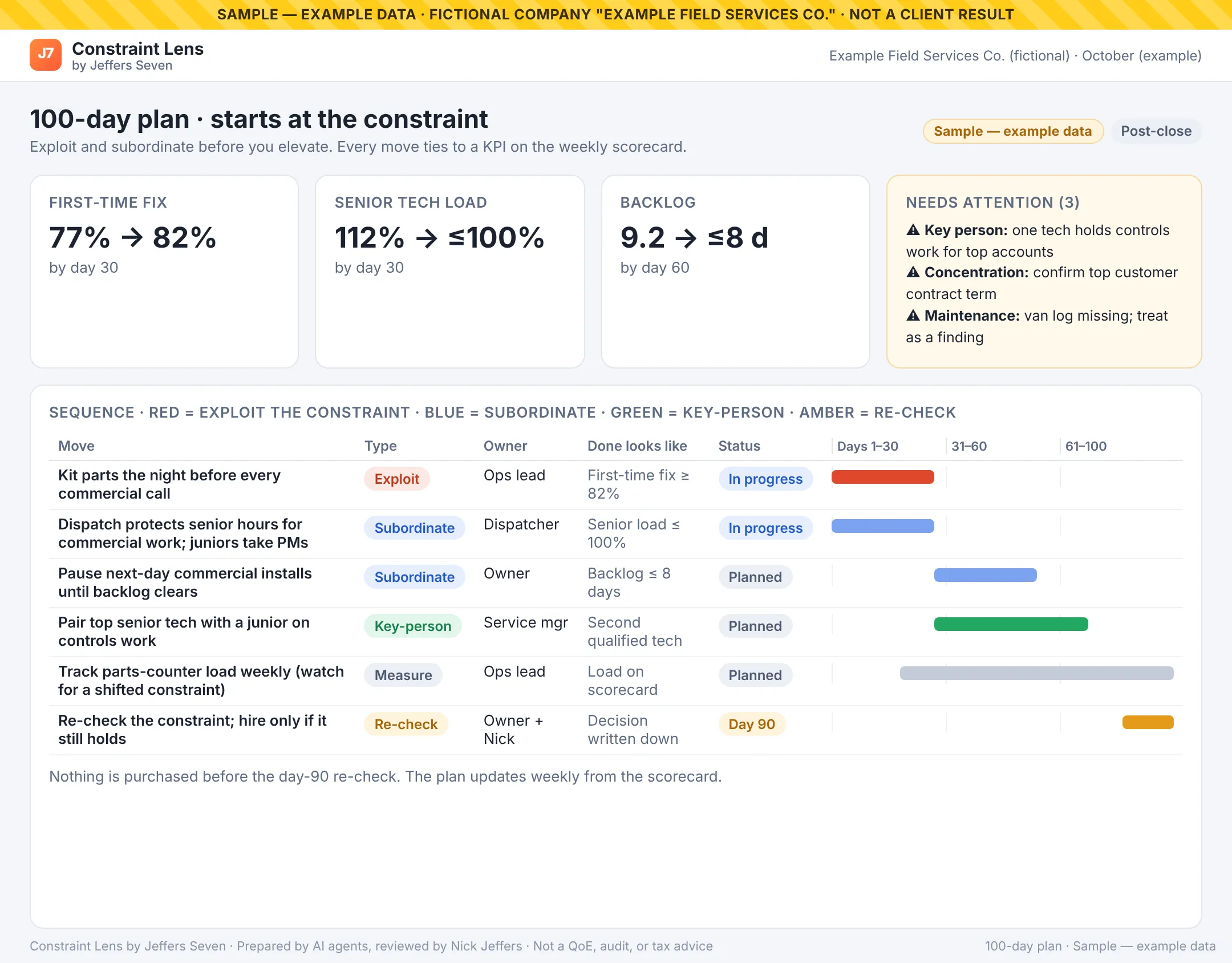
Sample 100-day plan, labeled Sample — example data, with targets (first-time fix 77% to 82%, senior load 112% to 100% or less, backlog 9.2 to 8 days or less), three red flags, and six moves on a day 1 to 100 timeline, each with type, owner, done test and status.
100-day planMoves sequenced on a timeline: exploit and subordinate first, a key-person fix, then a day-90 re-check before any hire. Red flags sit alongside.Sample — example data

Pricing

Built to earn equity, not hours.

The back office is paid at cost plus a small stake, so we only do well if the business does. Diligence can be paid once, or rolled into that stake.

Diligence, one-time

$2,500–$5,000

Fixed fee, set by deal size and complexity.

  • Full operations diligence package
  • Stand-alone, with no post-close commitment

Diligence, rolled in

No diligence fee

If you keep us on after close for back office and ops optimization.

  • Diligence rolls into the equity or EBITDA-share stake
  • Plus the monthly fee that covers our cost

Back office, post-close

Cost + small stake

A monthly fee that covers our cost, plus either:

  • About 5% equity, vesting over 3–4 years, or
  • A share of EBITDA growth

Terms are a starting point for you and your counsel. Nothing here is a fee quote, an offer to sell securities, or a commitment until it's in a signed agreement.

About

An operator, with an AI team doing the legwork.

Nick Jeffers has spent 25 years running manufacturing and operations: P&Ls, plant floors, supply chains and turnarounds. He directs a disclosed team of AI agents that produce the work, then reviews and signs off on every deliverable himself.

We complement your QoE, legal and accounting diligence. We don't replace them.

What we're not

  • Not a CPA, tax or payroll firm. No audits, opinions or tax positions.
  • Not a replacement for your accountant, counsel or QoE provider. We prepare work for them to review.
  • Not an operator. We don't run the business or take a general-manager seat.
  • Not a software vendor. The constraint lens is a review for the owner, using public methods.

Contact

See the full sample set.

The complete fictional set includes a diligence summary, a month-end close, an operating-rhythm package, the constraint-lens playbook, KPI templates and the working toolkit. Email Nick with your industry, deal size and LOI timeline, and ask for the samples.